An Exploration of Designing a Task Management Tool With Personal Task Prioritization
1 Overview
- This project examines Personal Task Management (PTM) not simply as recording schedules, but as an activity through which people create order, adjust priorities, and build a sense of control within changing everyday life. Based on this perspective, it redefines the limitations of existing digital task management tools in terms of personalization and flexibility.
- Through a review of prior research, user interviews, and a comparative analysis of existing apps, the project derived design directions for a PTM tool that incorporates personalized prioritization, and proposed a tool model that allows people to flexibly reorganize plans in response to changing daily conditions.
2 Context
People use Personal Task Management (PTM) behaviors to create order within the complexity of everyday life and carry out what they need to do. Satisfactory PTM is not only about getting tasks done. It also shapes pride in accomplishment, a sense of control over one’s life, and even personal identity. This project began from a simple question: while today’s digital tools support planning and task execution quite well, do they also provide a sufficiently satisfying and positive experience from the perspective of PTM?
In particular, existing personal task management tools tend to focus on recording and tracking what needs to be done, while offering limited support for flexible replanning that reflects users’ different situations and strategies. In response, this project aimed to propose a new model for a PTM tool that allows users to configure personalized prioritization rules, automatically reorder tasks when unexpected changes occur, and operate through a to-do-list-centered structure rather than a calendar-centered one.
In other words, this project approached task management by focusing less on recording itself and more on how to reflect each person’s own prioritization strategy.
3 Approach
3-1 Clarifying the Problem Through Literature and Case Review
The project first reviewed prior research on PTM and found that task management tools do more than assist with scheduling. They also help people negotiate goals and priorities and maintain a sense of predictability amid changing realities. Prior studies have mainly addressed factors such as importance, urgency, and deadlines, but this review showed that actual prioritization is shaped by a much broader set of internal and external factors, including emotion, motivation, mental and physical state, personal interests, efficient use of time, task context, environment, and social circumstances.
This review also helped identify recurring problems and requirements in existing PTM tools. Prior research pointed to several key challenges, including integrating different media, rearranging tasks in response to unexpected situations, determining which tasks can realistically be completed within a given time frame, enabling flexible scheduling, and monitoring current habits and actual progress. It also highlighted design requirements such as quick capture, flexible schedule creation and merging, item reordering, software interoperability, reminders, and task-moving functions.
The literature further showed that many users rely not on dedicated PTM apps alone, but on personalized combinations of general-purpose tools. It also suggested that failures in time management are not simply due to a lack of willpower, but are often caused by changing contexts and shifting judgments of value. This pointed to the need for flexible tools that can adapt to users’ strategies and changing situations, rather than fixed structures centered only on date, time, and place.
From this review, the need for personalization became a key premise of the project.
3-2 Identifying Real Prioritization Strategies Through User Interviews
After the literature review, interviews were conducted with eight participants, including undergraduate and graduate students, to understand the PTM tools they currently used and the factors that influenced how they prioritized tasks. The interview data were analyzed using an affinity diagram in order to identify common patterns and differences, and to examine how the issues described in prior research appeared in actual user behavior.
The key insights from the interviews were as follows:
- People preferred task management tools that allowed quick capture.
- When a single tool could not meet their personal needs, they combined multiple tools to create their own PTM environment.
- When planning a day, they often did not specify exact task start times in detail.
- They struggled to reorganize plans when unexpected changes occurred.
- Prioritization strategies differed across individuals and situations.
Looking more closely at participants’ responses, some considered importance, deadlines, and how quickly a task could be completed. Others considered time required or whether a task had a fixed time. Others still considered interest, enjoyment, available focus time, or whether they needed to leave room for unexpected situations. In other words, real-world prioritization could not be reduced to importance and deadlines alone. It was shaped in a much more layered way by condition, context, and daily circumstances.
Overall, the interviews showed that priority is not a fixed value, but an ongoing strategy that changes depending on personal situations and judgment.
3-3 Deriving Design Directions
By synthesizing the literature review and user interviews, the project established two overarching directions. The first was to sort tasks based on personalized prioritization criteria. The second was to allow plans to be adjusted fluidly in response to change.
A comparative analysis of existing PTM apps further showed that most current services rely on starred items, tiered priority levels, single sorting criteria, and manual modification. Based on these limitations, the project developed a more flexible alternative.
From this process, five design directions were derived.
-
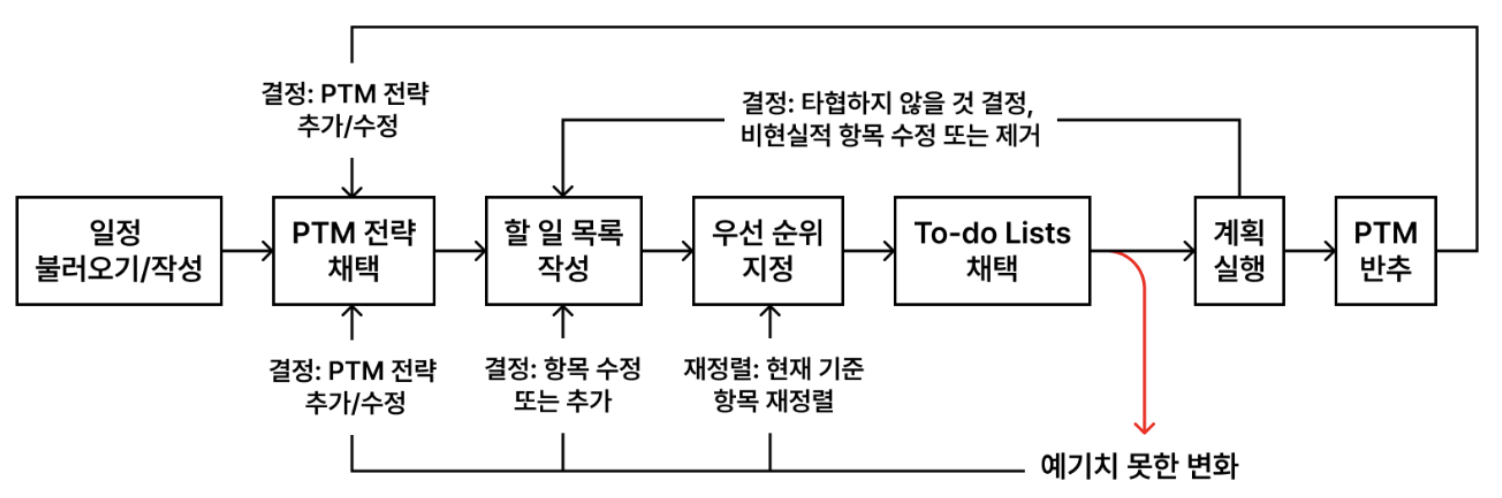
Direction 1Users should be able to import schedules from other services or enter them directly.Prior research pointed to the need to integrate multiple media and software, and the interviews likewise showed that users often construct PTM environments by combining multiple tools. Therefore, the new tool needed to function not as a closed standalone system, but as a structure that could accommodate both imported schedules and direct input.
-
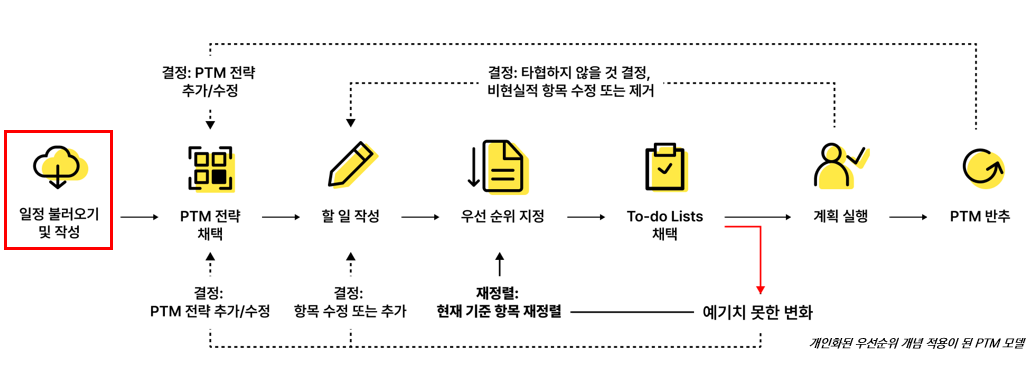
Direction 2Users should be able to flexibly add and change their own PTM strategies.Prior research suggests that many people behave like DIY users and that PTM behaviors themselves change over time. The interviews also showed that people use different prioritization strategies. Rather than imposing one fixed rule, the tool therefore needed to let users define and revise their own strategies.
-
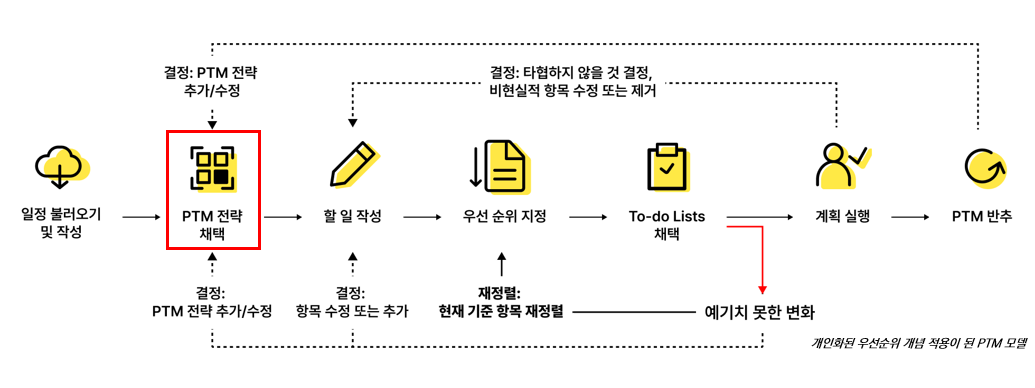
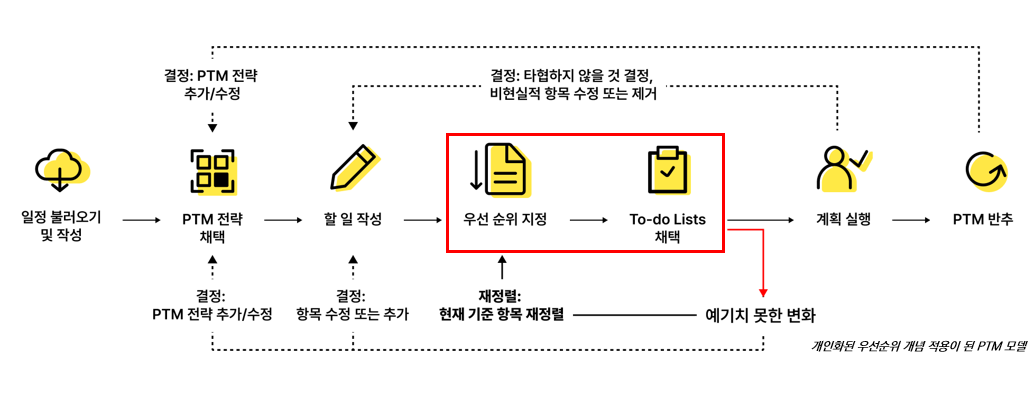
Direction 3A to-do list should include both basic task attributes and prioritization criteria.The project found that prioritization is shaped not only by content, place, and time, but also by criteria such as importance, deadlines, required time, needed concentration, and interest. Therefore, it proposed a to-do-list structure that includes the information users actually need in order to make prioritization decisions, rather than a simple title-based list.
-
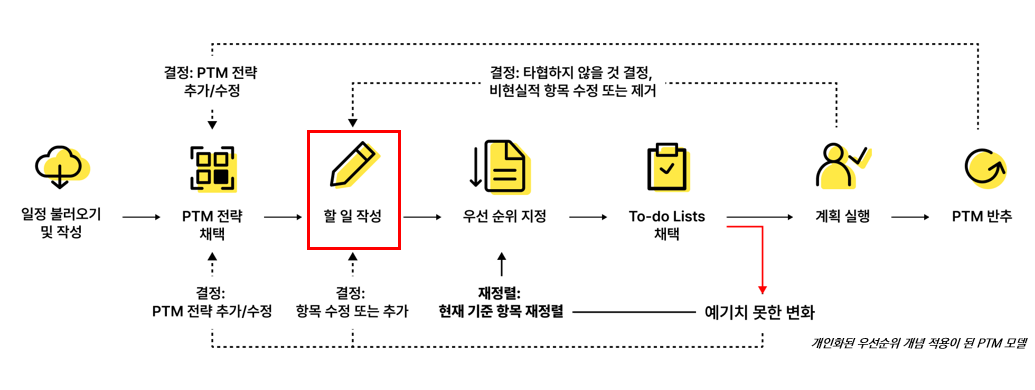
Direction 4The list should be sorted according to the prioritization rules of the selected strategy.The interviews showed that users decide what to do first based on different combinations of criteria, not on importance alone. Accordingly, the system was designed to sort tasks not by a single fixed criterion, but according to the rules of the PTM strategy selected by the user.
-
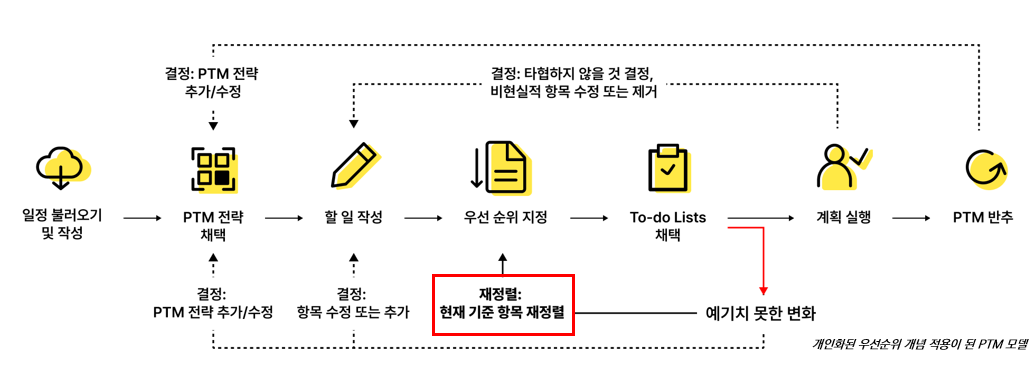
Direction 5When changes occur, the list should be reordered again according to that strategy.Prior research identified task rearrangement in response to unexpected situations and flexible replanning as major challenges, and the interviews confirmed that users struggle with these situations. Therefore, when schedules or tasks change, when strategies are revised, or when plans fail or are postponed, the system should automatically reorder the list according to the selected or updated rules.
4 Outcome
4-1 A PTM Tool Model Based on Personalized Prioritization
The final outcome of the project is a tool model and set of design guidelines for a PTM tool based on personalized prioritization. Rather than assigning fixed priority levels as existing apps do, this model allows users to define criteria that match their own strategies, sort tasks according to those rules, and then reorganize the list again as circumstances change.
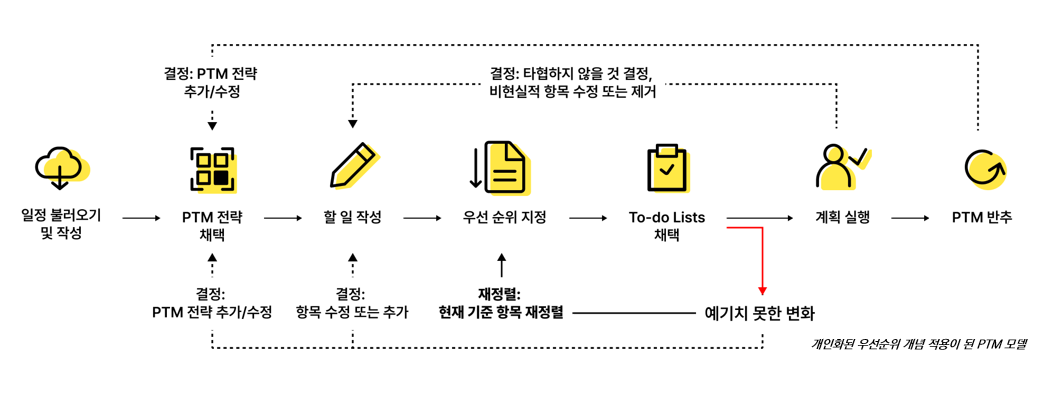 A conceptual diagram of the PTM model, in which to-do lists are sorted according to individual strategies and re-sorted whenever changes occur.
The core experience proposed by the tool is as follows:
- Users can import schedules from external services or enter them directly.
- Users can add and revise their own PTM strategies.
- Users can create to-do lists that include not only basic attributes such as content, place, and time, but also criteria relevant to prioritization.
- The system sorts the list according to the prioritization rules of the selected strategy.
- When schedules or tasks change, when strategies are modified, or when plans fail or are postponed, the system automatically reorders the list to reflect those changes.
4-3 Comparison with Existing Services
Existing services such as Microsoft To Do, Google Tasks, todoist, and TickTick typically provide starred items or tiered priorities, and mainly sort tasks by a single criterion such as title, date, or priority. When unexpected changes occur, users generally have to manually edit or delete items themselves. By contrast, the model proposed in this project treats the user’s PTM strategy itself as the object of personalization, and focuses on automatically reordering the list by reflecting both that strategy and changes to task items.
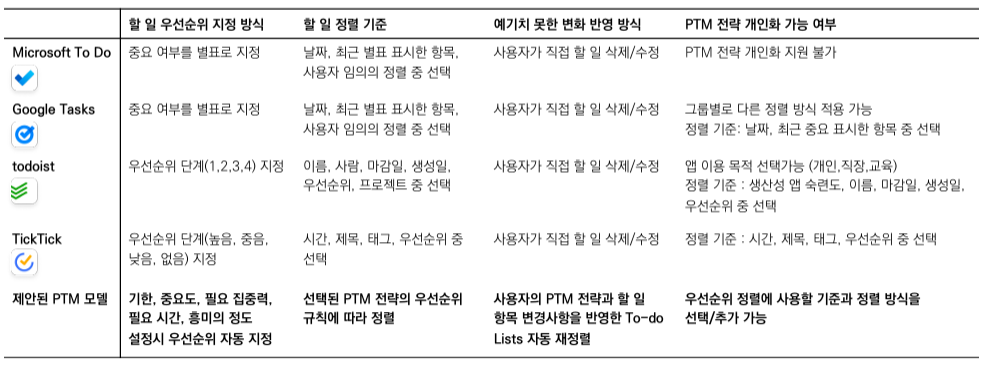 A table comparing the fixed priority system of the existing app with the personalized priority and automatic reordering structure of the proposed model.
5 Discussion & Conclusion
The significance of this project lies in reframing personal task management not as simple checklist maintenance, but as an activity of adjusting priorities in ways that reflect individual strategies and contexts. By connecting prior research, user interviews, and the analysis of existing apps, the project provides an empirical rationale for why personalized PTM tools are needed and proposes a to-do-list-based model and design guidelines accordingly.
Because this project focused on proposing a conceptual model and design directions, the next step is to translate these ideas into a concrete UI/UX and evaluate them at the level of actual user experience. Future work should therefore develop and study a UI/UX suitable for to-do lists that incorporate personalized prioritization.